

Interior designers use CAD (Computer-Aided Design) software because it eliminates guesswork, slashes rework costs, and transforms client presentations from hand-drawn sketches into precise, photorealistic 3D walkthroughs all before a single nail is hammered. If you have ever wondered why leading design firms rely on professional CAD drafting services instead of manual drawing, this guide breaks it all down.
From space planning and cost estimation to sustainability compliance and client approvals, CAD for interior design has become the industry’s backbone. With the global CAD software market projected to reach USD 44.38 billion by 2035 at a CAGR of 6.4%, the shift to digital is not a trend it is the new standard for interior designers across residential and commercial sectors worldwide.
Whether you are a residential designer in New York, a commercial fit-out firm in London, a furniture studio in Toronto, or a millwork company in Sydney, this guide explains exactly why AutoCAD for interior designers and professional CAD tools are non-negotiable in 2026.
CAD & Interior Design Market at a Glance (2026)
Before diving into the benefits, here is how significant the CAD and interior design industries have grown context that underlines just how important mastering CAD tools has become for design professionals worldwide.
| Statistic | Value / Source |
| Global CAD Software Market Value (2025) | USD 23.75 Billion — Business Research Insights |
| Global CAD Software Market Projection (2035) | USD 44.38 Billion at 6.4% CAGR |
| Global Interior Design Services Market (2026) | USD 153.85 Billion — Instant Interior AI |
| Interior Design Services Projection (2031) | USD 204.23 Billion |
| Large Manufacturers Using 3D CAD Platforms | Over 68% to optimise prototyping & reduce errors |
| North America CAD Market Share | 39.6% — largest global region |
| AI Adoption Among Interior Designers | Doubling yearly — 9% (2023) → projected 29% (2025) |
| Interior Design Market CAGR (2026–2030) | 4.4% — Technavio |
Get a Free Project Consultation
Unsure how CAD drafting can fit into your workflow? Fill out the form and our team will guide you step by step.
What Is CAD in Interior Design?
CAD, or Computer-Aided Design, is software that lets interior designers create accurate 2D floor plans, 3D models, and technical construction drawings digitally rather than on paper. The most widely used platform is AutoCAD by Autodesk, though SketchUp, Revit, and Chief Architect are also popular depending on project scope.
At its core, CAD interior design software gives designers a precise, scalable digital canvas where every measurement is exact, every element is movable, and every version is saved. This matters enormously when a client changes their mind about a kitchen island placement the day before a contractor quote is due.
For firms that need technical drawings without managing in-house drafters, outsourcing to a specialist team such as professional CAD Drafting Services has become a popular, cost-efficient solution across the USA, UK, Canada, Germany, and Australia.
7 Key Reasons Why Interior Designers Use CAD in 2026
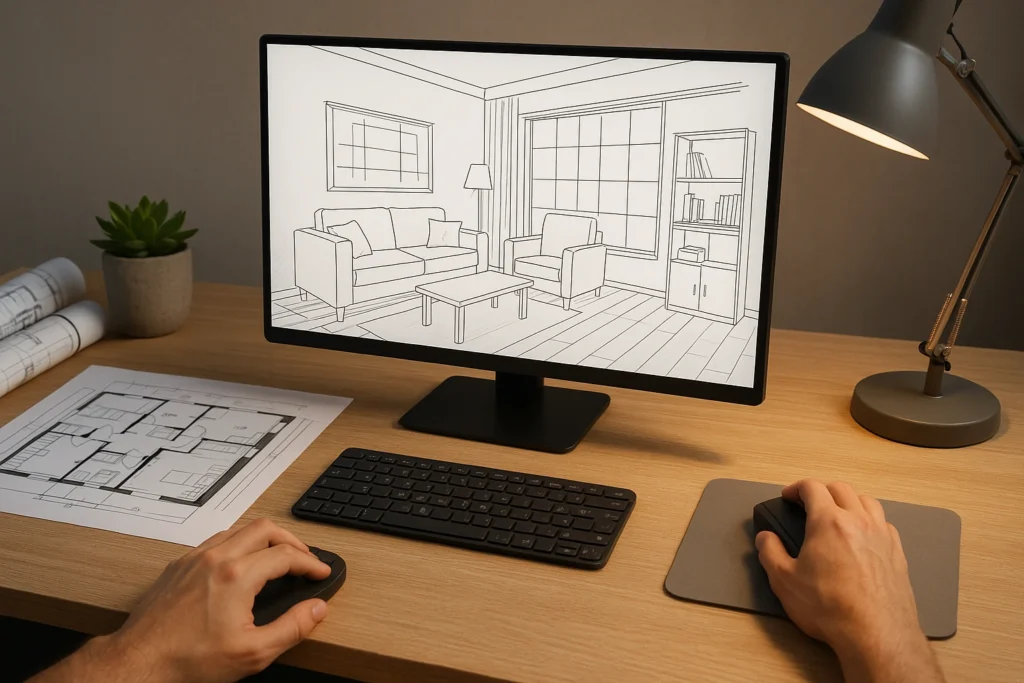
1. Precision Space Planning and Accurate Floor Plans
One of the most commercially valuable uses of CAD for interior design is space planning. Manual sketches are prone to scaling errors that don’t surface until furniture arrives on-site and by then, the cost of fixing the problem falls directly on the designer.
With CAD drafting software, every measurement is drawn to exact scale. Designers can place walls, doorways, windows, and furniture down to the millimetre, ensuring that a sectional sofa actually fits the living room or that an office layout meets fire exit regulations in the UK or ADA compliance standards in the USA.
Interior firms that offer professional CAD floor plan services command higher project fees and close more contracts because they demonstrate technical authority from the very first client consultation.
2. Photorealistic 3D Visualization and Client Presentations
Clients don’t buy what they can’t see. This is the single biggest reason interior designers use 3D CAD modeling today. A detailed 3D render communicates the look, feel, material palette, and lighting of a room in a way no mood board or hand sketch ever could.
The global interior design services market is expected to grow from $153.85 billion in 2026 to $204.23 billion by 2031. A large driver of this growth is client demand for immersive digital previews before projects begin. Designers who deliver high-quality 3D visualizations win more pitches consistently.
With services like 3D CAD Modeling, interior designers can outsource the rendering work entirely, receiving professional-grade visuals without investing in costly software subscriptions or training.
3. Significant Reduction in Rework Costs
Rework is the silent profit killer in interior design. When a design doesn’t translate correctly from concept to reality wrong dimensions, incompatible furniture, clashing material specs someone pays for the fix. Usually the designer.
CAD drafting eliminates most causes of rework before they happen. Designers can test multiple layout variations, swap materials, and adjust structural elements in minutes, not days.
Industry Insight: Firms using CAD tools report up to 40% fewer design errors compared to those relying on traditional manual methods. For a commercial fit-out in Chicago, Berlin, or Melbourne, a 40% error reduction translates directly to protected margins and stronger client retention.
4. Accurate Cost Estimation and Better Budget Control
Interior design budgeting without data is guesswork. With CAD software, every element in a design from wall square footage to furniture count to material quantities is automatically tracked and measurable. This means designers can generate accurate material takeoffs and project cost estimates directly from the drawing file.
This capability is particularly valuable for millwork and custom furniture projects. A designer speccing bespoke cabinetry for a high-end kitchen in London needs exact dimensions and material volumes to get accurate fabrication quotes. Professional millwork drafting services integrated into the CAD workflow make this process seamless.
5. Faster Revisions and Unlimited Design Iteration
Speed is a competitive advantage. When a client at the first review meeting says ‘I love it, but can we try the bedroom in a warmer tone with a different wardrobe configuration?’, the designer who responds with an updated render by the next morning wins the client’s lasting trust.
AutoCAD and 3D modeling software make this level of responsiveness possible. Layers can be toggled, components swapped, and colour schemes updated in hours. Crucially, previous versions are preserved, so designers can demonstrate concept evolution and let clients compare options side-by-side.
6. Standardized, Industry-Ready Documentation
Interior design projects involve multiple stakeholders: architects, structural engineers, contractors, furniture manufacturers, and building authorities. Every one of them needs drawings in a specific, readable format.
CAD design services produce drawings in universally accepted formats (DWG, DXF, PDF) that contractors can work from directly, builders can submit for planning permission, and furniture makers can use for production.
For firms delivering projects in regulated markets such as Germany, Australia, Canada, and the UK where building compliance documentation is rigorous this standardization is not optional. It is the baseline.
7. Support for Sustainable and Energy-Efficient Interior Design
Sustainability is no longer a premium selling point it is a baseline client expectation in 2026. The good news is that CAD software supports sustainable interior design in measurable, verifiable ways.
Designers can model room orientations for natural light optimization, calculate material volumes to minimize waste, plan efficient HVAC and electrical routing, and even integrate with BIM (Building Information Modeling) platforms for whole-life carbon assessments.
Over 68% of large design and manufacturing firms already use 3D CAD platforms to optimize material usage and reduce waste. For clients seeking BREEAM certification in the UK, LEED compliance in the USA, or Green Star ratings in Australia, a designer who integrates CAD-driven sustainability planning is a significantly more attractive hire.
Top CAD Software Interior Designers Use in 2026
Here is a quick reference guide to the most commonly used CAD platforms for interior designers across the USA, UK, Canada, Germany, and Australia:
| Software | Best For | Key Strength |
| AutoCAD | 2D floor plans, construction docs | Industry-standard precision drafting |
| SketchUp | 3D concept visualization | Intuitive, fast 3D modeling |
| Revit | Large commercial BIM projects | BIM integration & collaboration |
| Chief Architect | Residential design (USA/Canada) | Built-in home design workflows |
| 3ds Max | Photorealistic rendering | Luxury visual presentations |
| Vectorworks | Multidisciplinary design firms | Architecture + interiors in one tool |
CAD for Residential vs. Commercial Interior Design
Residential CAD projects typically focus on space planning, furniture layout, kitchen and bathroom detailing, and 3D visual presentations for homeowner approvals. The priority is visualization and client communication helping everyday clients see and trust the final outcome.
Commercial CAD projects are more documentation-heavy. Office fit-outs, retail interiors, and hospitality spaces require detailed construction packages, compliance drawings, and coordination with MEP (mechanical, electrical, and plumbing) contractors. In these contexts, professional CAD drafting services that produce complete, construction-ready documentation packages are not optional they are essential.
Both sectors benefit significantly from accurate CAD work, but the deliverables, stakeholder complexity, and regulatory requirements differ which is why many design firms choose to hire CAD designers or partner with specialist outsourcing providers rather than managing all technical drawing in-house.
Why Outsourcing CAD Drafting Is a Smart Business Decision
Running a successful interior design business means managing client relationships, creative direction, site visits, and business development not spending hours redrawing floor plans. This is why outsourcing CAD design services has grown rapidly across the USA, UK, Germany, Canada, and Australia.
By partnering with a professional CAD drafting firm, interior designers can:
- Deliver faster turnarounds on client proposals and pitch presentations
- Access specialist skills (millwork detailing, 3D furniture modeling, CAD conversion services) without full-time hiring costs
- Scale capacity up or down based on project load no idle staff during quiet periods
- Reduce overheads associated with in-house drafting teams, software licences, and hardware upgrades
- Focus on high-value client-facing work while technical production is handled by experts
About Shalin Designs
Shalin Designs provides professional CAD drafting services, 3D CAD modeling, millwork drafting, CAD conversion, and furniture design services to interior designers, architects, and furniture manufacturers across the USA, UK, Canada, Germany, Australia, and Europe. Every project is NDA-protected and delivered with a guaranteed response within 24 hours.
CAD Drafting Services by Region USA, UK, Canada, Germany & Australia
Shalin Designs serves interior designers and architecture firms across all key global markets. Here is what makes our regional service delivery relevant to your market:
USA — CAD Drafting Services
ADA compliance, local zoning codes, and high-volume commercial fit-out work make precise CAD documentation essential. We serve clients across New York, Los Angeles, Chicago, Houston, and beyond delivering AutoCAD floor plans, 3D renders, and millwork shop drawings to tight deadlines.
UK — CAD Drafting Services
From London residential refurbishments to Manchester commercial interiors, UK designers rely on accurate CAD drawings for planning permission, building regulations, and BREEAM documentation. We understand British standards and deliver accordingly.
Germany & Europe — CAD Drafting Services
German and broader European design markets demand DIN-compliant technical documentation and metric precision. Our team delivers drawings in DIN A formats, with full support for EU regulatory requirements across Germany, Netherlands, Belgium, and beyond.
Canada — CAD Drafting Services
Canadian interior design projects span vast residential markets and commercial sectors. We support designers in Toronto, Vancouver, Calgary, and Ottawa with complete CAD packages from initial concept drawings to construction documentation.
Australia — CAD Drafting Services
Australian designers working across residential renovations and commercial fit-outs in Sydney, Melbourne, Brisbane, and Perth trust our team for BCA-aware drawings, 3D models, and millwork documentation delivered to Australian building standards.
Key Takeaways
The answer to why interior designers use CAD is straightforward: because it makes projects more accurate, more profitable, and more competitive. From the first client pitch to the final construction handover, CAD drafting for interior design delivers precision and speed that manual methods simply cannot match.
As the global interior design market pushes toward $204 billion by 2031 and CAD software adoption accelerates, designers and firms that invest in professional CAD capabilities whether in-house or through outsourcing will consistently outperform those that don’t.
- Precision: CAD eliminates measurement errors that cause costly on-site fixes
- Speed: Revisions that once took days now take hours
- Profit: Fewer errors and rework mean stronger project margins
- Credibility: Professional CAD drawings signal expertise to clients and contractors
- Scalability: Outsourcing CAD drafting lets you grow without growing headcount
Ready to Upgrade Your CAD Workflow? Contact Us and get a free project consultation within 24 hours.