
 Sophia S February 26, 2026
Walk into any architecture firm in London, a manufacturing plant in Birmingham, or a construction office in New York, and you’ll find shelves filled with legacy drawings, scanned blueprints, and outdated PDFs. As digital transformation accelerates, businesses are increasingly turning to cad conversion services in USA and the UK to modernize these archives into accurate, editable digital formats.
In 2026, automated CAD conversion is no longer a back-office task it’s actually a strategic advantage. From startups to large engineering firms, companies are using intelligent drafting automation to reduce errors, improve efficiency, and stay competitive in a fast-evolving market.
What Are CAD Conversion Services in USA?
CAD conversion services in USA refer to the process of transforming paper drawings, scanned blueprints, raster images, and outdated CAD files into fully editable digital formats such as DWG, DXF, or BIM-compatible files.
These services help architects, engineers, manufacturers, and construction firms modernize legacy documentation while maintaining scale accuracy, layer structuring, and compliance with industry standards.An accurate cad conversion service typically combines automated tools with professional quality checks, delivering speed without compromising technical precision.
Why Is Automated CAD Conversion Growing So Fast?
The growth isn’t random. It’s tied to broader industry shifts.
According to research from McKinsey & Company, the construction sector has historically lagged in productivity growth, but digital adoption can significantly improve efficiency and cost performance. Similarly, Autodesk research highlights that firms using digital drafting and BIM-integrated systems reduce rework and improve coordination accuracy across teams.
In practical terms:
- Manual drafting – slow, error-prone, and difficult to scale
- Automated CAD conversion – faster turnaround, consistent accuracy, scalable output
Why Are UK and USA Businesses Prioritizing CAD Automation in 2026?
United States
The US construction and manufacturing industries are under mounting pressure from:
- Labour shortages across skilled trades
- Tighter project timelines and delivery expectations
- Rising material and operational costs
- Increasing federal and state compliance requirements
Businesses investing in cad conversion services in USA are particularly focused on:
- Large-scale infrastructure modernization
- Commercial property upgrades and retrofits
- Industrial manufacturing and smart factory implementation
United Kingdom
In the UK, digitization has been strongly driven by BIM mandates and digital construction strategies supported by organizations such as the National Building Specification (NBS). UK firms are converting legacy archives to:
- Meet Level 2 and Level 3 BIM compliance
- Enable cloud-based team collaboration
- Improve sustainability and carbon documentation
- Standardize engineering records across contractors
For many UK businesses, CAD conversion is no longer optional it’s essential for regulatory alignment and long-term operational efficiency.
Read Also : All You Need to Know About CAD Conversion Services: A Comprehensive Guide
What Are 2D CAD Conversion Services and Who Needs Them?
2D CAD conversion services specifically focus on converting scanned or paper-based 2D cad drawings including floor plans, elevations, sections, and mechanical schematics into fully editable CAD files.
Unlike 3D modelling or BIM workflows, 2D CAD conversion services are ideal for:
- Architecture firms digitizing planning submissions
- Manufacturers updating legacy machine drawings
- Engineering firms standardizing historical project files
- Facilities management teams building digital asset registers
2D CAD conversion services are typically the entry point for businesses beginning their digitization journey, converting physical drawings before moving into more advanced BIM or 3D modelling workflows.
What Problems Does CAD Conversion Solve?
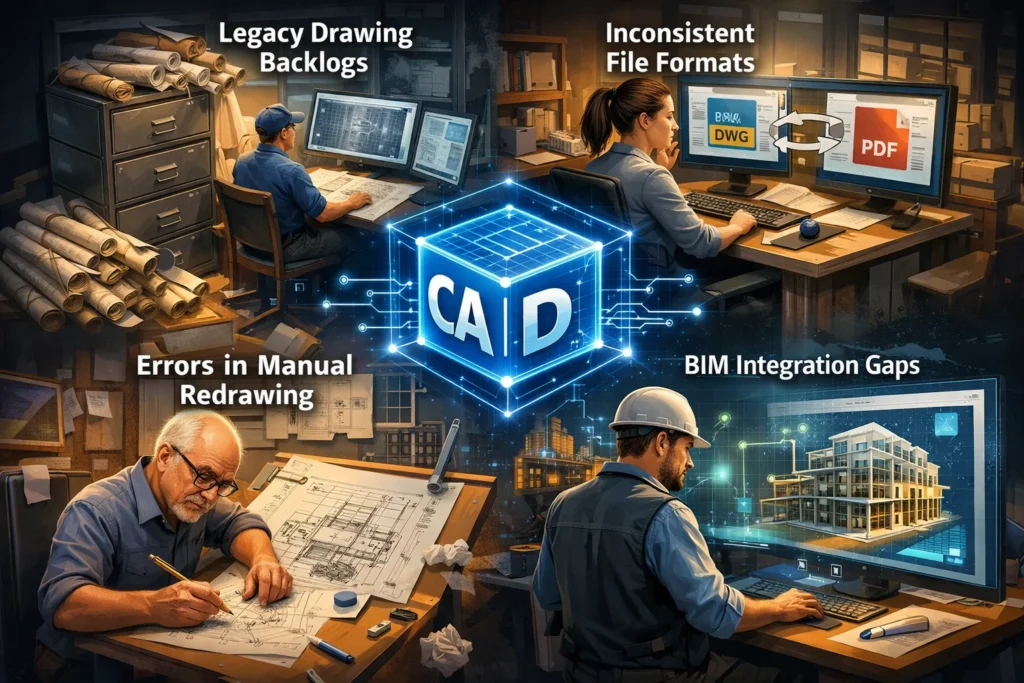
Businesses typically approach CAD conversion when facing one of these challenges:
1. Legacy Drawing Backlogs
Thousands of paper drawings stored in physical archives. Manual redrafting could take years. Automation shortens that timeline dramatically. What once took months can be completed in weeks.
2. Inconsistent File Formats
Older projects may include scanned TIFF files, low-resolution PDFs, hand-marked revisions, or outdated CAD versions. A structured conversion service standardizes layers, scales, line weights, and dimensions for seamless integration into modern workflows.
3. Errors in Manual Redrawing
Human-driven redrawing increases dimension inconsistencies, layer mismanagement, annotation errors, and compliance risks. Automated workflows combined with professional oversight significantly reduce these inaccuracies.
4. BIM Integration Gaps
Many firms hold valuable legacy drawings that cannot be imported into modern BIM environments without conversion. PDF to DWG and raster-to-vector workflows bridge this gap, enabling teams to fully leverage tools like Revit and AutoCAD.
Read Also: The Future of CAD: Why 2D to 3D CAD Conversion Is Gaining Global Momentum
How Does Automated CAD Conversion Actually Work?
Many assume it’s simply software clicking ‘convert.’ In reality, it’s a structured hybrid model combining software intelligence with professional expertise. Here’s the standard workflow:
- File Analysis – Evaluate source quality, resolution, and drawing type
- Raster to Vector Processing – Convert scanned images into editable vector geometry
- Layer Structuring – Organise elements according to industry or client standards
- Manual Quality Review – Correct distortions, gaps, or missing data
- Dimension Verification – Cross-check scale accuracy against source documents
- Final Output Delivery – DWG, DXF, or BIM-compatible format as required
Tools such as AutoCAD and Revit are standard in professional environments to ensure compatibility. Automation accelerates the process but expertise ensures reliability.
Is Automated CAD Conversion Cost-Effective?
Yes, particularly when applied at scale.
Manual drafting consumes skilled labour hours, extended review cycles, and multiple correction phases. Automated systems reduce processing time significantly, especially in bulk projects.
Businesses evaluating cad conversion services in USA typically assess:
- Cost per drawing
- Turnaround time
- Accuracy and error rate
- Revision and correction policies
- BIM and software integration capability
Costs typically range from $5–$50 per drawing, depending on complexity, source quality, and volume. Bulk projects offer better per-drawing economics and measurable ROI, often recovering investment within a single project cycle.
What Industries Benefit Most from CAD Conversion Services?
Construction & Real Estate
- Building renovation and retrofit digitization
- Infrastructure modernization projects
- Property management archive updates
Manufacturing
- Legacy machine and component drawings
- CNC-ready file preparation
- Plant layout and facility digitization
Engineering Firms
- Structural and civil plan conversion
- Mechanical drafting updates
- Electrical system redesign
Government & Public Infrastructure
- Municipal archive digitization
- Compliance documentation
- Smart city and transport planning initiatives
What Are the Risks of Poor CAD Conversion?
Choosing the wrong provider creates real downstream consequences:
- Dimension misalignment that affects fabrication
- Incorrect scale interpretation leading to on-site errors
- Missing technical annotations causing contractor disputes
- BIM incompatibility delaying project delivery
This is why experienced organisations don’t simply choose the lowest-cost option infact they prioritize an accurate CAD conversion service with a structured QA process. Precision errors discovered after fabrication cost significantly more to correct than getting the conversion right the first time.
Read Also: Why You Might Need CAD Conversion Services?
How Is AI Influencing CAD Conversion in 2026?
AI-powered tools now assist with:
- Pattern recognition in scanned drawings
- Automatic layer classification
- Engineering symbol detection
- Handwritten text extraction
- Batch processing of large drawing sets
This significantly reduces manual input and speeds up delivery timelines. However, for engineering-critical files where a 2mm dimensional error has real-world consequences professional validation does remains non-negotiable. The most effective providers use AI to accelerate production and human expertise to guarantee output quality.
How to Find the Best CAD Conversion Service Provider?
Not all providers deliver the same results. When evaluating the best CAD conversion service provider for your business, apply these criteria:
Industry Experience
Does the provider understand the difference between architectural, mechanical, and structural drawings? Sector-specific knowledge directly affects output quality.
Accuracy Standards
What QA process ensures dimensional precision? Look for multi-stage review workflows. The best CAD conversion service provider will clearly define their accuracy guarantee and correction policy upfront.
Technology Stack
Are they using current versions of AutoCAD, Revit, or equivalent professional tools?
Scalability
Can they handle bulk conversion with consistent turnaround? Request a pilot project before committing to large volumes.
Data Security
Are engineering drawings protected under NDA? What data handling and storage protocols are in place?
Selecting the right partner is a strategic decision not just a procurement exercise.
Ready to Digitize Your Legacy Drawings?
Shalin Designs' CAD conversion team works with architecture, engineering, and manufacturing firms across the USA and UK. Get a free project assessment.
Is Automation Replacing Human Draftsmen?
No, it’s redefining their role.
Rather than spending time on repetitive tracing work, skilled drafts people now focus on:
- Overseeing QA and accuracy verification
- Optimising design workflows and layer standards
- Integrating converted files into BIM environments
- Collaborating cross-functionally with architects and engineers
Automation handles volume and speed. Professionals ensure accuracy, compliance, and technical judgement. The firms that understand this balance outperform those who rely on one or the other exclusively.
What Is the Future of CAD Conversion in the UK and USA?

The trajectory is clear. By 2027 and beyond, expect:
- Cloud-based collaborative CAD platforms with real-time multi-user access
- Full BIM-integrated conversion pipelines from scan to model
- AI-assisted drafting correction with reduced human intervention
- Real-time digital twin compatibility for infrastructure projects
- Standardized cross-border drafting formats for international project teams
As digital construction strategies expand, CAD conversion will become foundational infrastructure not just a specialist back-office function.
Modernize Your Engineering Archives with Shalin Designs
The rise of automated CAD conversion is part of a larger digital transformation reshaping architecture, engineering, and manufacturing across the UK and USA. For firms still managing paper archives or incompatible file formats, the cost of inaction grows with every project.
Shalin Designs’s CAD conversion specialists deliver accurate, BIM-compatible, professionally verified outputs at scale, on time, and within budget.
What you get:
- Structured raster-to-vector and PDF to DWG processing
- Multi-stage QA review for dimensional accuracy
- DWG, DXF, and BIM-ready output formats
- Secure data handling with full NDA protection
- Dedicated project manager from brief to delivery
Looking for a dependable CAD conversion partner? Shalin Designs delivers accurate, secure, and BIM-compatible CAD conversion services for firms across the USA and UK. Get in touch today for a complimentary project consultation.